

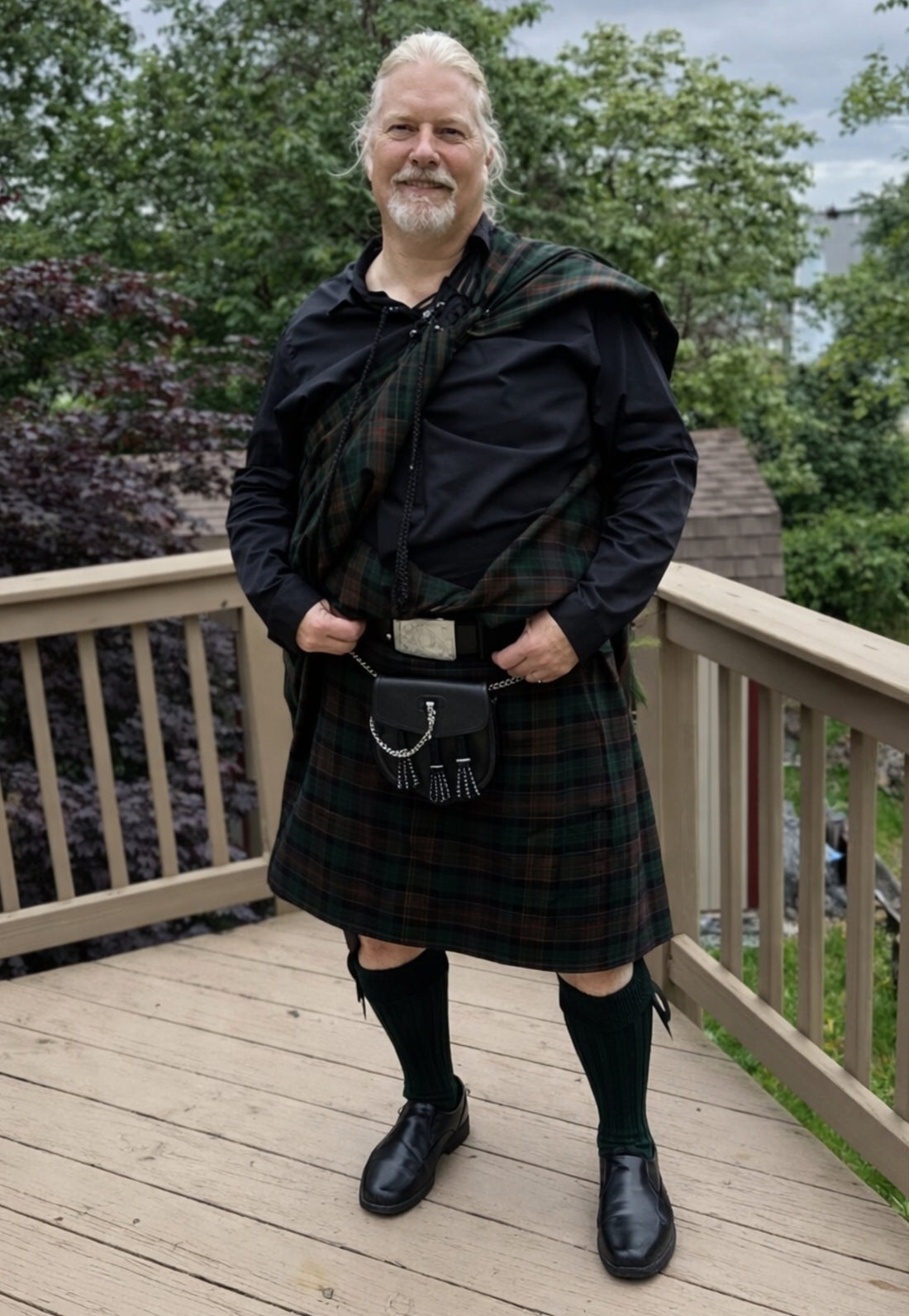
Great Kilt | Feileadh Mòr
One length of tartan, woven to the registered sett, belted at the waist and drawn over the shoulder. There is no sewing in a Great Kilt. It is cloth, pleated by the wearer. Cut to your yardage, not to a size label.
We select this for you the moment you enter your measurements. Your waist sets the band, and a mid-knee length over 27″ adds a yard (over 30″, two) so the pleats keep their proportion on a taller frame. The yardage charge updates with it. Change it by hand if you want to, and we will show that you have.
How much cloth sits above the belt — what you gather and pin at the shoulder. We weave to 52″ at the widest, and your mid-knee length comes off that first, so each depth adjusts with your length rather than promising fixed inches.
There is no sewing in a Great Kilt. These decide how it arrives, how heavy the folds sit, which shoulder it drapes over, and how the cut ends are finished. None can be changed afterwards.
Add all 0 essentials and save up to $0.00.

Before the kilt was tailored, it was worn
Belted at the waist, gathered by hand, thrown over the shoulder and pinned. No buckles, no stitching, no size. Two and a half centuries before the modern kilt existed, this was Highland dress, and it is still cut the same way in our workshop.
The garment your ancestors actually wore.
Le Grand Kilt
Le Grand Kilt, également appelé « Feileadh Mor » en gaélique écossais, est un vêtement traditionnel qui fait partie intégrante de la culture écossaise depuis longtemps. Ses origines remontent à 1603. Il était porté par les membres des clans des Highlands pour se protéger et assurer leur mobilité au combat et à la chasse. Il existait une variante du « plaid ceinturé », avec des plis à la taille. Il était généralement fabriqué en laine acrylique et mesurait environ 5 à 10 mètres de long. On le portait généralement enroulé autour de la taille, puis drapé sur les épaules et sur le corps. Cela offrait une protection chaude contre les rigueurs du climat écossais et offrait une grande liberté de mouvement. Il a évolué au fil du temps et diverses variantes ont été développées. Parmi les modèles populaires, on trouve le « plaid ceinturé », qui consistait à faire des plis autour de la taille et à les attacher à une ceinture en cuir, facilitant ainsi les mouvements.
Si vous aimez regarder des vieux films, notamment Outlander, vous avez sans doute déjà vu le style de kilt dont je parle. Appelé « Great kilt », il est doté d'un tissu supplémentaire qui permet de le porter sur les épaules . Confectionné dans les meilleurs tissus tartan, ce kilt peut créer un look « Braveheart ». Il est parfait pour les occasions traditionnelles, les festivals des Highlands et les événements officiels. Non seulement il apportera une touche de style, mais il rehaussera également la tenue et la prestance de celui qui le porte. Chez Scottish Kilt, nous proposons le Great Kilt avec des « plis trompeurs » pour plus de commodité. Il peut être laissé plissé. Le tablier est bordé de franges. Avec ses « plis trompeurs », le Great Kilt symbolise la tradition et la culture écossaises, porté lors des grandes occasions. Le porter demande de la pratique et de l'habileté, mais le résultat est un look distinctif qui attire tous les regards.
Comment mesurer un grand kilt ?
Tour de taille : Il est important de déterminer le tour de taille à partir de votre tour de taille comme vous mesureriez votre pantalon.
Mesure de la longueur : Mesurez la longueur de votre taille jusqu'au milieu de votre genou. Faites appel à un professionnel, car vous risquez de vous tromper si vous le faites vous-même.
Conseils de dimensionnement :
5 mètres : il est idéal pour les hommes dont le tour de taille va jusqu'à 34 à 42 pouces.
6 Yards : parfait pour les hommes qui ont un tour de taille allant jusqu'à 40" - 48''
7 Yards : parfait pour les hommes qui ont un tour de taille allant jusqu'à 46" - 54''
8 yards : parfait pour les hommes qui ont un tour de taille allant jusqu'à 52" - 60''
9 Yards : parfait pour les hommes qui ont un tour de taille allant jusqu'à 58" - 66''
10 yards : parfait pour les hommes qui ont un tour de taille allant jusqu'à 64" - 72''
Questions fréquemment posées
Q. Quel est ce kilt que l'on voit lors des foires de la Renaissance ?
R. Oui, c'est le type de kilt porté lors des foires de la Renaissance ; cependant, tous les kilts de la Renaissance ne sont pas ainsi. Vous devez décider du style que vous souhaitez créer en le portant.
Q. Quelle est la différence entre un grand kilt et un kilt moderne ?
A. Le Grand Kilt était un vêtement traditionnel porté dans les Highlands écossaises, tandis que le kilt moderne est plus court et plus léger, descendant généralement jusqu'au genou. Chez Scottish Kilt, nous proposons les deux types de kilts pour répondre aux besoins de nos clients.
Every detail, considered.
- No sewing, by designOne uncut length, the historic garment
- Woven to the registered sett5,000+ tartans, 700+ ready to cut now
- Yardage matched to your waistOur published 5–10 yd banding, checked live
- Selvedge kept on both edgesLoom edge as the hem, no fraying
- Cheater pleats to sett or stripeTacked not stitched, reversible to flat
- Left or right shoulderDrape side set before cutting, at no charge
- Premium acrylic yarnSoft handle, colour-fast, machine friendly
- Docket shipped with the clothEvery number you approved, printed
Made to be worn, not just owned.
The kilt does not make the man, but the man who chooses one well walks taller for it.
Highland gatherings, reenactment field days, handfastings, Burns Night, and the first quiet morning you lay nine yards out on the floor and work out that your grandfather knew how to do this.
The things people ask before they order
A single long length of tartan pleated by hand at the waist, held with a belt, and draped over the shoulder. It predates the stitched kilt and was the everyday Highland garment before the eighteenth century. There is no sewing in it.
A modern kilt is stitched, pleated and ends at the knee. A Great Kilt is one unstitched piece covering the lower and upper body at once, pleated fresh each wear and held by a belt rather than buckles and straps.
By waist. Our table runs 5 yd for 34–42″, 6 yd for 40–48″, 7 yd for 46–54″, 8 yd for 52–60″, 9 yd for 58–66″, 10 yd for 64–72″. Enter your waist and the matching bands are marked FIT. Eleven yards and above is not about fit. It is extra depth of wrap and a longer plaid, with 13 yards being the full traditional length.
No pleats is flat cloth, the authentic garment. Cheater pleats to sett tacks the pleats so the whole pattern repeats across the run. To stripe puts one chosen stripe down every pleat: the pipe-band look. Both are tacked, not sewn, so the cloth can be returned to flat.
Left is traditional. It keeps the right arm and sword hand free, and it is how the plaid appears in every clan portrait. Right-shoulder drape is chosen by left-handed wearers and by pipers whose drones sit on the left. We finish the ends to suit whichever you pick, at no extra cost, but it cannot be changed after cutting.
The cloth only. Belt, buckle, sporran, plaid brooch and shirt are separate products. Add them above and everything ships together in one box.
A Great Kilt is sized by cloth length, not tailoring, so there is very little to get wrong once the yardage band is right. If we cut against the numbers you approved, we remake it free.
From customers, to community
Tag @scottishkiltshop or share at FreeKilt.com for a chance to be featured.
Shop by Inspiration
Made to Measure. Made to Last.
Each piece is expertly tailored, carefully finished and fitted to perfection, honouring Scotland's rich tailoring tradition.


Recently viewed
Pick up where you left off.
